
Quick answer: Here is how to calculate one rep max (1RM) without maxing out: lift a challenging weight for 3–10 good reps, then use a formula. The Epley formula is: 1RM = weight × (1 + reps ÷ 30). For example, 100 kg for 5 reps gives an estimated 1RM of about 117 kg, with no risky max attempt needed.
Testing a true max means loading the bar, saying a quiet prayer and hoping your spotter is paying attention. Good news: you rarely need to. A solid set of five tells you almost as much, and you get to keep your dignity.
Strength coaches have long used repetition-maximum testing to set training loads. The ACSM's resistance training position stand (opens in a new tab) frames intensity in terms of repetition maximums, like an 8–12 RM for beginners.
What Is a One Rep Max?
Your one rep max is the heaviest weight you can lift for a single rep with good form. It's the standard way to describe strength on lifts like the squat, bench press and deadlift.
There are two kinds:
- Tested 1RM: you actually lift it. Accurate, but tiring and riskier.
- Estimated 1RM: calculated from a lighter set of several reps. Safer, and accurate enough for most training.
How to Calculate One Rep Max With a Formula
Pick a set you did recently, ideally 3–10 reps, taken close to failure with good form. Then plug the weight and reps into one of these.
Epley formula
1RM = weight × (1 + reps ÷ 30)
Example: 100 kg × 5 reps → 100 × (1 + 5 ÷ 30) = 100 × 1.167 = 116.7 kg
Brzycki formula
1RM = weight × 36 ÷ (37 − reps)
Example: 100 kg × 5 reps → 100 × 36 ÷ 32 = 112.5 kg
The formulas give slightly different answers, and that's fine. Pick one and stick with it, so your numbers stay comparable over time. What matters most is whether your estimate is going up.
Which set should you use?
- Use 3–10 reps. Estimates get less reliable the more reps you do.
- Use a hard set. A set where you had five reps left in the tank will underestimate your strength.
- Skip warm-ups. They aren't close to your limit, so they'll drag the estimate down.
One Rep Max Percentage Chart
Once you know your estimated 1RM, you can work backwards to choose training weights. These percentages come from the Epley formula and are estimates; your own numbers may differ, especially on high-rep sets.
- 1 rep: 100%
- 2 reps: ~94%
- 3 reps: ~91%
- 4 reps: ~88%
- 5 reps: ~86%
- 6 reps: ~83%
- 8 reps: ~79%
- 10 reps: ~75%
- 12 reps: ~71%
Example: If your estimated bench 1RM is 100 kg and your program calls for 5 sets of 5, start around 80–85 kg and adjust based on how the sets feel.
How to Test a True One Rep Max Safely
If you do want a real max, for a powerlifting meet or just curiosity, set it up properly.
- Warm up thoroughly: a few lighter sets, building up gradually.
- Use a spotter or safety bars: non-negotiable for bench press and squats.
- Ramp in singles: go from about 85% to 90% to 95%, resting a few minutes between each.
- Attempt your max: if it moves with good form, you can try a small jump. If form breaks down, stop.
- Stop on a success: don't keep going until you fail.
Weak: "Load up a big number and see what happens."
Strong: "Warm up, single at 90 kg, single at 97.5 kg, then attempt 102.5 kg with safety bars set."
Beginners usually don't need a true max test. Estimates are safer and plenty accurate for setting training weights. If you have a heart condition, high blood pressure or a recent injury, check with a doctor before any maximal lift; MedlinePlus has a good overview of exercise and fitness safety (opens in a new tab).
How to Use Your 1RM in Training
Your one rep max is useful as a ruler, not a goal in itself.
- Set working weights: many programs prescribe loads as a percentage of 1RM.
- Track progress: compare an estimated 1RM across sessions, even when sets use different weights and reps. That's how you tell if 80 kg × 8 beat 85 kg × 6. It's the backbone of progressive overload.
- Spot plateaus: if your estimate stays flat for several weeks, it's time to change something.
- Compare relative strength: divide your 1RM by your bodyweight to see how strong you are for your size.
When to Recalculate Your One Rep Max
Recalculate whenever you hit a new best set, and at minimum every 4–8 weeks. If your program uses percentages, update it at the start of each new block.
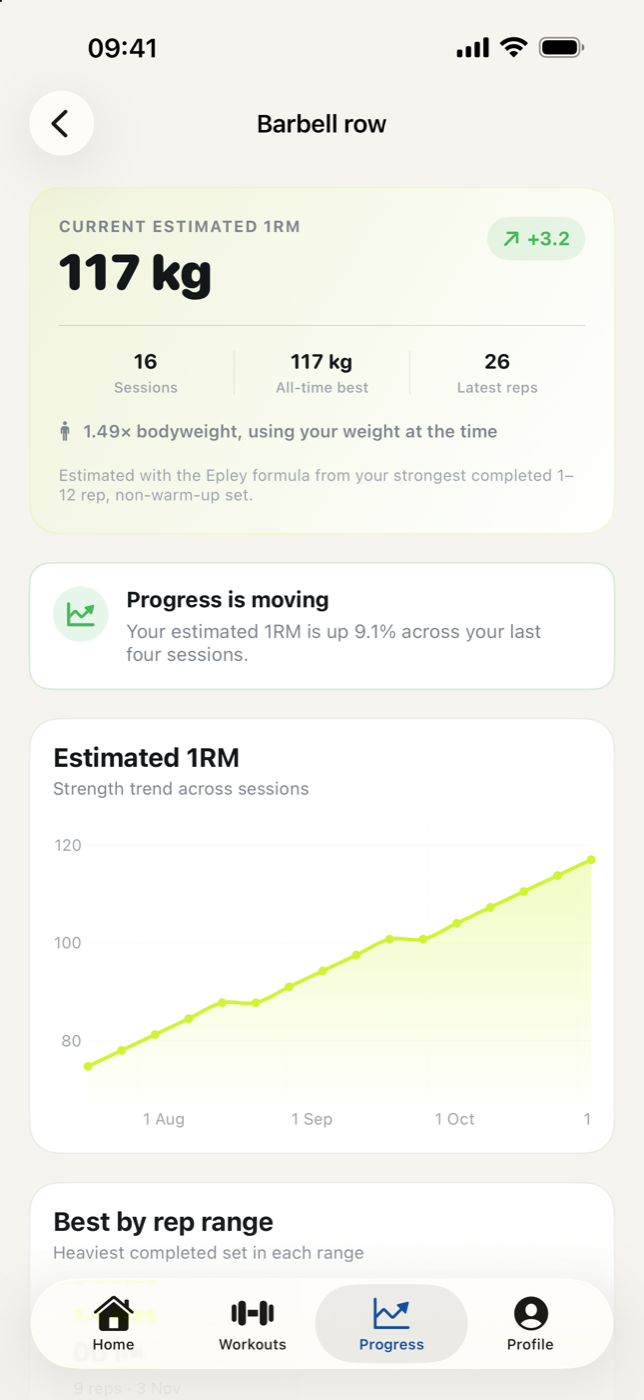
A tracking app makes this automatic. Verto calculates your estimated 1RM for every lift using Epley from your strongest completed set of 1–12 reps, ignoring warm-ups, and charts it on the Progress tab.
Common One Rep Max Mistakes
- Using sloppy reps: a half-rep set gives a flattering but useless estimate.
- Using very high-rep sets: a set of 20 tells you more about endurance than max strength.
- Testing too often: maxing out every week is tiring and rarely adds strength.
- Mixing formulas: switching between Epley and Brzycki makes your trend jump around for no reason.
- Treating the estimate as exact: it's a guide. Some days the bar will feel heavier than the math says.
Frequently Asked Questions
How accurate is a one rep max calculator?
A one rep max calculator gives a reasonable estimate, but not an exact number. Accuracy is best with hard sets of roughly 3–10 reps and gets worse at higher reps. Use it to set training weights and track trends, and treat any single estimate as approximate.
What is the best formula to calculate 1RM?
Epley and Brzycki are the two most widely used formulas, and both work well for sets of up to about 10 reps. Neither is clearly best for everyone. What matters most is using the same formula every time so your progress is comparable.
How often should you test your one rep max?
Most lifters don't need to test a true max more than a few times a year. Estimated 1RMs can be updated every session from your normal working sets. If you track workouts in an app like Verto, your estimate updates automatically after every workout.
Should beginners test their one rep max?
Usually not. Beginners gain strength quickly and are still learning technique, so a true max attempt adds risk for little benefit. Instead, estimate it from a solid set of 5–8 reps and focus on adding reps or weight week to week.
Is a 5 rep max better than a 1 rep max test?
For most people, yes. A 5 rep max is less risky and less tiring, and it still gives a good 1RM estimate through a formula. It also uses a weight you'll actually train with, so the number is immediately useful for programming.
Track Your One Rep Max Automatically
Your one rep max is the best single number for seeing whether you're getting stronger. Calculating it by hand works, but long division between sets is nobody's idea of a warm-up. Let Verto do the math on every set and chart your estimated 1RM for every lift, while you focus on the lifting.