
Quick answer: A push pull legs split organizes training by movement. Push day trains chest, shoulders and triceps. Pull day trains back and biceps. Legs day trains quads, hamstrings, glutes and calves. Run it 3 days a week to train each muscle once, or 6 days to train each muscle twice.
Picking a workout split can feel like ordering at a restaurant with a twelve-page menu. Push pull legs (PPL) is the dish everyone keeps recommending, and for good reason: it's simple, it's flexible, and it gives every muscle group its own day in the spotlight.
How often you train each muscle matters. A 2016 meta-analysis on training frequency (opens in a new tab) found that training major muscle groups at least twice a week produced more growth than once a week, which is why the 6-day PPL is so popular.
What Is the Push Pull Legs Split?
The push pull legs split groups exercises by what your muscles do.
- Push: muscles that push weight away. Chest, front and side shoulders, and triceps. Think bench press and overhead press.
- Pull: muscles that pull weight toward you. Upper back, lats, rear shoulders and biceps. Think rows and pull-ups.
- Legs: everything below the waist. Quads, hamstrings, glutes and calves. Think squats and Romanian deadlifts.
Because muscles that work together are trained together, they get to rest together. Your chest recovers on pull day, your back recovers on legs day, and your legs recover while you complain about being sore on the stairs.
Who Should Use a PPL Split?
PPL works for most people who lift weights. It suits some better than others.
- Intermediate lifters: a great fit, especially the 6-day version, which allows plenty of weekly volume.
- Busy lifters with 3 days: the 3-day version works, but each muscle is only trained once a week.
- Beginners: they can run PPL, but a full-body or upper/lower plan often makes more sense early on, because it trains each muscle more often with fewer total days.
- Training days: the ACSM position stand on resistance training (opens in a new tab) suggests 2–3 days a week for novices, 3–4 for intermediates and 4–5 for advanced lifters. Pick the PPL version that matches.
- Strength athletes: PPL can work, but powerlifting programs often organize around the squat, bench and deadlift instead.
Pros and Cons of a Push Pull Legs Split
No split is perfect. Here's the honest trade-off.
Pros
- Simple to plan: every exercise has an obvious home. Bench goes on push day, rows go on pull day, and nobody argues about it.
- Focused sessions: a whole day for one group of muscles means you can do enough work for each without marathon workouts.
- Natural recovery: muscles that work together rest together, so overlapping fatigue is low. Your triceps aren't still tired from bench when you need them for overhead press.
- Scales with your schedule: the same structure works at 3, 4, 5 or 6 days a week.
- Easy to track: repeating the same sessions each week makes progress obvious.
Cons
- Six days is a big commitment: to train every muscle twice a week, you need six sessions. Miss one and the rotation shifts.
- Once a week on 3 days: the 3-day version trains each muscle only once a week, which is less than the twice-weekly frequency research favors.
- Legs get one day per round: quads, hamstrings, glutes and calves share a single session, which can make legs day long and brutal.
- Some overlap still happens: heavy deadlifts on pull day also tax your lower back and hamstrings before legs day.
The 3-Day Push Pull Legs Split
The 3-day version runs each workout once per week, with rest days in between.
Example week: Monday push, Wednesday pull, Friday legs. Rest on the other days.
Because each muscle gets only one session a week, use a few more sets per exercise than you would on a 6-day plan.
Push day (3-day plan)
- Barbell bench press: 4 × 6–8
- Overhead press: 3 × 6–8
- Incline dumbbell press: 3 × 8–12
- Cable lateral raise: 3 × 12–15
- Triceps pushdown: 3 × 10–12
Pull day (3-day plan)
- Pull-up or lat pulldown: 4 × 6–10
- Barbell row: 4 × 6–8
- Seated cable row: 3 × 8–12
- Face pull: 3 × 12–15
- Dumbbell curl: 3 × 10–12
Legs day (3-day plan)
- Back squat: 4 × 5–8
- Romanian deadlift: 3 × 6–10
- Leg press: 3 × 10–12
- Leg curl: 3 × 10–12
- Standing calf raise: 4 × 10–15
The 6-Day Push Pull Legs Split
The 6-day version runs the cycle twice a week, so every muscle is trained twice.
Example week: Push, pull, legs, push, pull, legs, rest.
To avoid repeating identical sessions, make the first round heavier and the second round more about higher reps.
Heavy push / Volume push
- Heavy push: bench press 4 × 5–6, overhead press 3 × 6–8, weighted dips 3 × 6–8, lateral raise 3 × 12–15
- Volume push: incline dumbbell press 3 × 8–12, seated dumbbell press 3 × 10–12, cable fly 3 × 12–15, lateral raise 3 × 15–20, overhead triceps extension 3 × 10–12
Heavy pull / Volume pull
- Heavy pull: deadlift or rack pull 3 × 4–6, weighted pull-up 3 × 5–8, barbell row 3 × 6–8, hammer curl 3 × 8–10
- Volume pull: lat pulldown 3 × 10–12, chest-supported row 3 × 10–12, face pull 3 × 12–15, incline curl 3 × 10–12
Heavy legs / Volume legs
- Heavy legs: back squat 4 × 4–6, Romanian deadlift 3 × 6–8, walking lunge 3 × 8 per leg, calf raise 4 × 8–10
- Volume legs: front squat or hack squat 3 × 8–10, leg press 3 × 12–15, leg curl 3 × 10–12, leg extension 3 × 12–15, seated calf raise 4 × 12–15
That's a lot of training. If six days leaves you exhausted, the 5-day option below is a good middle ground.
Push Pull Legs Exercise List and Swaps
The plans above are templates, not commandments. Swap exercises for ones that suit your equipment, joints and goals, as long as each one trains the same movement.
Push day exercises
- Horizontal press: barbell bench press, dumbbell bench press, machine chest press, push-ups
- Vertical press: overhead press, seated dumbbell press, machine shoulder press
- Incline press: incline barbell or dumbbell press, incline machine press
- Chest isolation: cable fly, pec deck, dumbbell fly
- Side delts: dumbbell lateral raise, cable lateral raise, machine lateral raise
- Triceps: pushdown, overhead extension, skull crusher, close-grip bench press, dips
Pull day exercises
- Vertical pull: pull-up, chin-up, lat pulldown, assisted pull-up
- Horizontal pull: barbell row, chest-supported row, seated cable row, one-arm dumbbell row
- Rear delts and upper back: face pull, reverse fly, reverse pec deck
- Biceps: barbell curl, dumbbell curl, incline curl, hammer curl, preacher curl
- Hip hinge (optional): deadlift or rack pull, if you don't do it on legs day
Legs day exercises
- Squat pattern: back squat, front squat, hack squat, goblet squat, leg press
- Hip hinge: Romanian deadlift, stiff-leg deadlift, hip thrust, good morning
- Single-leg: walking lunge, Bulgarian split squat, step-up
- Hamstring curl: lying, seated or standing leg curl
- Quad isolation: leg extension
- Calves: standing calf raise, seated calf raise, leg-press calf raise
Verto's exercise library has more than 900 exercises, filterable by muscle and equipment, so finding a swap takes seconds.
How long should a PPL workout take?
Most PPL sessions in the plans above take about 45–75 minutes, depending on rest times. Rest longer after heavy compound sets and shorter after isolation work. For heavy loading, the ACSM position stand (opens in a new tab) recommends 3–5 minutes between sets. Lighter isolation sets usually need far less.
Example rest plan: 2–3 minutes after squats, bench and rows; 60–90 seconds after curls, raises and pushdowns.
Running PPL in a busy gym
Waiting twenty minutes for the bench on Monday, international chest day, is a rite of passage. It doesn't have to wreck your session.
- Have a backup for every lift: dumbbell press if the bench is taken, hack squat if the racks are full.
- Reorder isolation work: if the cable station is free now, do your face pulls now.
- Train at off-peak times: early mornings and late evenings are usually quieter.
- Keep the movement, not the machine: progress counts as long as you track the same exercise next week.
Other PPL Variations
- 4-day PPL: run push, pull, legs, push one week, then pull, legs, push, pull the next. The rotation keeps going.
- 5-day PPL + upper/lower: push, pull, legs, then an upper day and a lower day. Each muscle gets trained twice in five days.
- Legs, push, pull: some lifters move legs first, so pull day is never right after a heavy deadlift session. Order matters less than consistency.
Here's how those look across a calendar week:
3 days: Mon push · Wed pull · Fri legs
4 days (rotating): Week A: Mon push · Tue pull · Thu legs · Fri push. Week B: Mon pull · Tue legs · Thu push · Fri pull.
5 days: Mon push · Tue pull · Wed legs · Fri upper · Sat lower
6 days: Mon push · Tue pull · Wed legs · Thu push · Fri pull · Sat legs
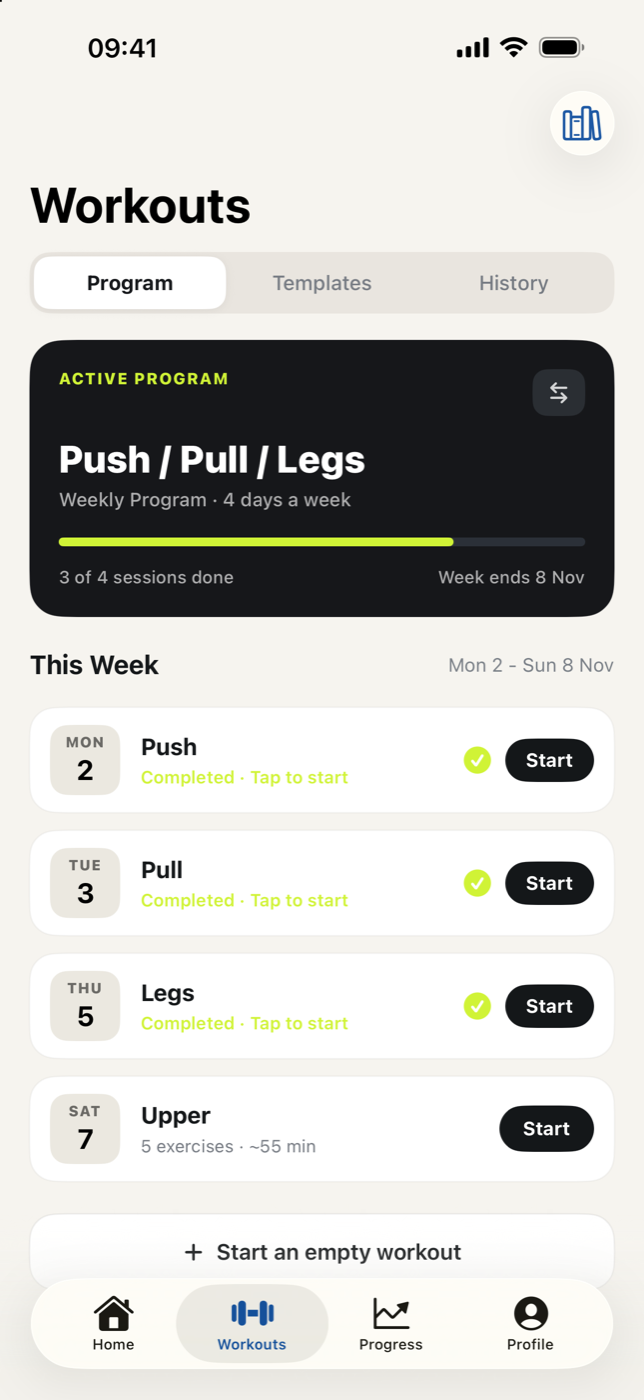
The rotating 4-day version is the trickiest to keep track of, because the days shift every week. A planner that shows "up next" removes the guesswork, which is exactly what Verto's home screen does. If you miss a day on any version, just do the next session in order instead of skipping it. The rotation is forgiving; your legs, less so.
How to Progress on a Push Pull Legs Split
A great split does nothing if the numbers never go up. Use double progression on every exercise.
- Pick a rep range: for example, 6–8.
- Build reps: add reps until every set reaches the top of the range.
- Add weight: increase by the smallest step and drop back to the bottom of the range.
A 12-week PPL block
Structure the months, not just the weeks. Here's a simple way to run a PPL block. The numbers are a starting template, not a prescription.
- Weeks 1–4: start each exercise with 2–3 reps in reserve. Add reps or weight each week.
- Weeks 5–8: push a little harder, finishing most sets 1–2 reps from failure. Keep adding weight where you can.
- Week 9: take a deload week: same exercises, about a third fewer sets.
- Weeks 10–12: return to your best working weights and aim for new rep records.
After week 12, review your log. Keep the exercises that progressed, swap the ones that stalled, and start the next block.
Weak: "Do push day, feel the pump, go home."
Strong: "Bench 4 × 6–8 at 80 kg. When all four sets hit 8, go to 82.5 kg."
For the full method, read our guide to progressive overload.
Balancing Weekly Volume on PPL
A common question is whether PPL gives each muscle enough work. Count your hard sets per muscle per week, counting a set as half for muscles that only assist. Here's the 6-day plan above, counted that way:
- Chest: about 13 sets (bench, dips, incline press, cable fly)
- Upper back and lats: about 12 sets (pull-ups, two rows, pulldowns), plus deadlifts
- Side delts: 6 direct sets, plus half-sets from overhead pressing
- Rear delts: 3 direct sets, plus half-sets from rows
- Biceps: 6 direct sets, plus about 6 more from half-sets of pulling, so roughly 12
- Triceps: 3 direct sets, plus about 8 from pressing, so roughly 11
- Quads: about 16 sets (squats, lunges, hack squat, leg press, leg extension)
- Hamstrings: 6 direct sets, plus deadlifts on pull day
- Calves: 8 sets
Most of that sits inside the commonly recommended 10–20 range. Our guide to how many sets per muscle group per week explains how to set your targets.
Watch out for the muscles PPL tends to shortchange:
- Rear delts: add face pulls or reverse flyes on pull day.
- Hamstrings: include both a hip hinge (Romanian deadlift) and a knee curl.
- Side delts: lateral raises on both push days help a lot.
Verto's muscle map colors each muscle by its working sets over the last 7 days, so under-trained groups stand out right away.
Push Pull Legs vs Other Workout Splits
PPL isn't the only good split. The best one is the one you'll actually follow.
- Push pull legs vs upper/lower: upper/lower trains every muscle twice in four days. PPL takes six days to do the same, but each session focuses on fewer muscles. Choose upper/lower for four days a week, and PPL for six.
- Push pull legs vs full body: full body trains every muscle in every session, usually three days a week. It's great for beginners and busy schedules. PPL gives each muscle more sets per session, with fewer muscles per day.
- Push pull legs vs bro split: a bro split trains one muscle group per day, so each muscle gets one session a week. PPL on six days doubles that frequency, which is a better fit with the frequency research above.
- Push pull legs vs arnold split: the arnold split pairs chest with back, then shoulders with arms, then legs. It's also usually run six days a week, but chest and back fatigue overlap more.
Not sure? Start with whichever split matches the number of days you can train most weeks, then stick with it for at least 8–12 weeks before judging it.
Common Push Pull Legs Mistakes
- Doing too much on day one: eight exercises per session is a recipe for skipping session four.
- Ignoring legs: the split says "legs" for a reason. Skipping it turns PPL into "push pull, pull push."
- Starting with 6 days as a beginner: build up from three or four days first.
- Random weights every week: without tracking, you can't apply progressive overload.
- Never deloading: six hard days a week builds fatigue. Plan a deload week every so often.
Frequently Asked Questions
Is push pull legs good for beginners?
Push pull legs can work for beginners, but it isn't always the best first choice. A 3-day full-body plan trains each muscle more often in the same number of days. Beginners who enjoy the structure of PPL can start with three or four days a week and progress steadily.
How many days a week should you do push pull legs?
Most people run push pull legs three, four, five or six days a week. Six days trains each muscle twice and suits intermediate lifters. Three days trains each muscle once and fits busy schedules. Pick the version you can repeat consistently for months.
Is push pull legs better than upper/lower?
Neither is better for everyone. Upper/lower trains each muscle twice in four days, while PPL needs six days to do the same. PPL gives each muscle group more attention per session. Choose based on how many days you can train each week.
What order should you do push pull legs in?
Push, pull, legs is the most common order, but legs, push, pull works well too. It separates heavy pulling and leg work. The best order is the one that fits your schedule and lets you recover between similar sessions. You can plan it in Verto's workout planner.
Can you build muscle with a 3-day push pull legs split?
Yes. You can build muscle on a 3-day push pull legs split if you train hard, use enough sets and apply progressive overload. Because each muscle is trained once a week, include a few more sets per session than on a 6-day plan.
When should you do cardio on a push pull legs split?
Do cardio on rest days or after lifting, not before heavy sessions. Easy cardio like walking or cycling is fine almost any day. Keep hard intervals away from legs day, since tired legs make squats and deadlifts harder. Two or three short sessions a week fit most PPL schedules.
Plan Your Push Pull Legs Split in Verto
Push pull legs is popular because it's simple, flexible and hard to mess up, as long as you actually do legs day. Pick your days, log your sets and make the numbers climb. Verto's workout planner lays out your PPL week and prefills every set from last time.